The Last Illusion: When Human Labor Becomes Unnecessary
There are moments in history when a people believe they are merely undergoing another technological change, when in truth they are walking beyond the very idea of work. The entire world is living this moment. But almost no one sees what is truly approaching.
The clearest reflection lies in recent memory: the fight of the taxi drivers against Uber. They thought they were defending their livelihood against a technological fad. They did not understand that they were defending a way of life against an economic model impossible to defeat. In the end, they lost: they lost their jobs, they lost the market, they lost their meaning. And, ironically, Uber replaced them with a multitude of exhausted immigrants, working ten or twelve hours per day, without contract, without protection, without future.
The consumer, crushed between bills and insufficient wages, chose — as always — the cheapest option. Morality is a luxury when life is a struggle.
What no one understood — and many still do not understand — is that Uber was not about transportation. It was a dress rehearsal for what is now happening to the entire economy.
Digital platforms were only the first sign. Artificial intelligence is the final blow.
The New Absolutism: The Machine Works, the Human Waits
Who will hire humans when machines are ten, twenty or a hundred times cheaper, faster and more precise? Who will pay for vacations, sick leave, training, and labor regulations… when there is a system that works 24 hours a day, without pauses and without complaints?
The economic logic is inescapable: In the competition between flesh and algorithm, the algorithm always wins.
Believing that “new professions will appear” is repeating the lullaby that put every generation to sleep in every technological revolution. But this one is different.
Before, technology automated tasks. Now it automates skills. Next it automates decision. Finally, it automates the need for the human being.
And even so, at innovation events the same narcotic discourse is repeated:
“AI will be an opportunity.” “Technology will create more jobs.” “Everything will be fine.”
No. It will not be fine. Not without a profound transformation in the structure of the economy, politics, and the collective consciousness.
The Market Will Not Save the Worker — It Never Has
The uncomfortable truth is simple: neither the State, nor companies, nor institutions will protect the worker from this transition. It is not malice. It is systemic logic.
The market has only one criterion: efficiency. And when efficiency becomes absolute, the human becomes residual.
The consumer — the very human who will be replaced — will always choose the lowest price. This is how societies collapse: Not because someone wishes to destroy human labor, but because everyone, pressured by the cost of existing, inadvertently collaborates in its destruction.
The Undisclosed Future
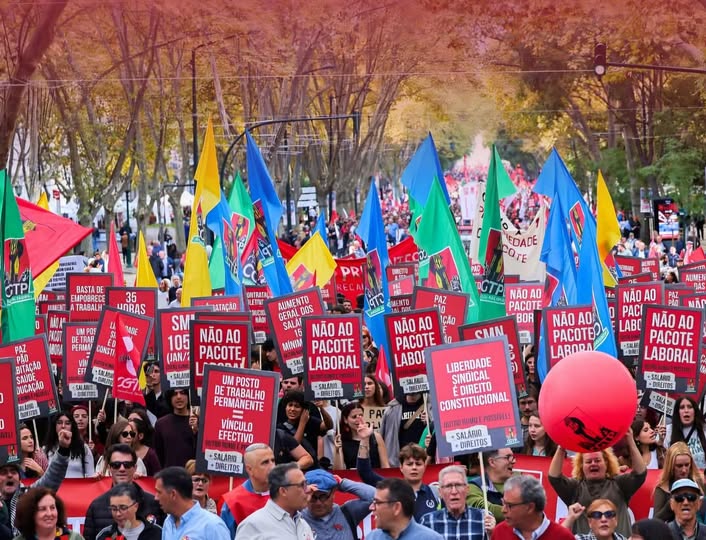
The organizers of strikes, protests and demonstrations should stand on stage and tell the naked truth:
“Within a few years, many of those marching here today will be unemployed — and they will not be hired again in the traditional way.”
This is not pessimism. It is realism. And it is an ethical responsibility to announce it before despair takes over families and nations.
Because a post-work society is being born. And no one has explained to workers that they are the sacrifice of this transition.
The Only Way Forward: A New Economy of Human Value
If machines produce everything, value can no longer come from labor. It must come from consciousness — not because it is spiritual in a dogmatic sense, but because it is the only domain the machine does not possess, does not live and cannot fully simulate.
This is where the paradigm of income through consciousness is born: the value generated by automated systems must return to the human being, not as charity, but as an ethical and civilizational structure.
The future will not be decided by technology. It will be decided by policies that defend the spiritual principle — that is, the capacity of a society to reorganize itself around what makes the human more than a biological intermediary between machines.
The Word must become Fire: lucid, radical, transfigurative. Only thus will the human being cease to be a shadow in the luminous corridor of the machinic world it has created.