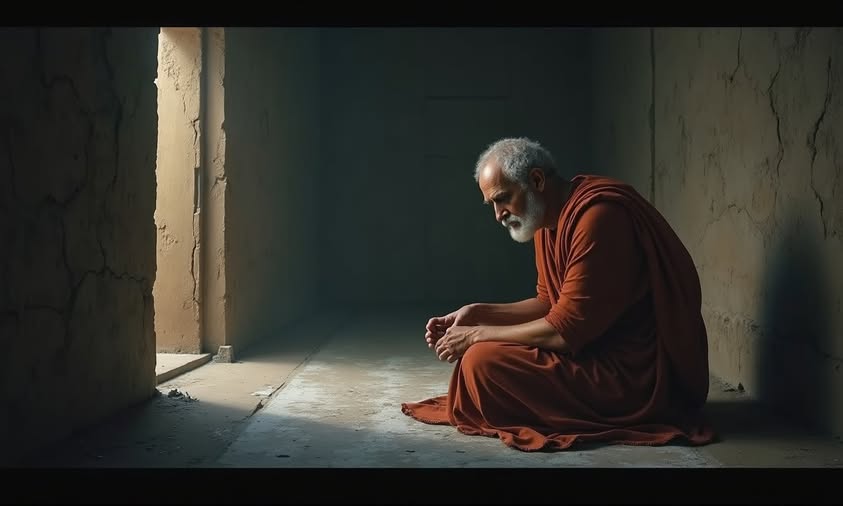
 The Death of Socrates and the Invisible Tribunal
Socrates did not die only in Athens, in the year 399 BC.
He continues to die in every age where truth rises against power.
His trial was not against one man, but against the very freedom to think.
They accused him of corrupting the youth, of rejecting the gods of the city, of questioning the laws of democracy.
But the true accusation was another:
 he dared to awaken consciousness.
 The Tribunal of the City
In that tribunal, democracy revealed its paradoxical face:
The same assembly that proclaimed liberty could not tolerate one who dared to cross the limits of obedience.
Socrates was not condemned for lying, but for a truth too vast to fit within temples and ballots.
He could have fled. Crito offered him that possibility.
But the philosopher refused, for to flee would be to confess that his life of thought had been a farce.
He preferred death to the betrayal of his principles.
 The Cup of Hemlock
When he drank the poison, he did so serenely, as one fulfilling a ritual.
His last words — “We owe a cock to Asclepius” — remain an enigma.
Yet perhaps they mean this: death is a cure, and philosophy is the medicine of the soul.
Athens believed it was silencing a man.
In truth, it was eternalizing a voice.
 The Invisible Tribunal of Today
The tribunal has changed form, but has not disappeared.
Today they do not condemn with hemlock — they condemn with silence.
They cancel on social media.
Discredit in newspapers.
Drown in lawsuits, debts, and taxes.
They transform truth into “fake news” and lies into “official reality.”
The modern cup contains not vegetal poison, but the invisible venom of debt.
Those who refuse to obey the system are condemned not to physical death, but to economic and social suffocation.
 The New Sophist: Money
In Socrates’ Athens, the sophists sold words to manipulate opinion.
Today, the new sophists are the Central Banks and the lords of finance:
They create money out of nothing.
Sell illusions of credit.
Ensnare nations and peoples in invisible chains of debt.
Like the sophists, they care not for truth, but for power.
And, as in Athens, those who expose them are deemed enemies of order.
 The Socrates of Today
You, me, anyone who dares to say:
that debt feeds the monster;
that banks rule more than parliaments;
that nations are hostages in a circular game where the house never loses;
…that person becomes a new Socrates, summoned before the invisible tribunal of our time.
And the choice remains the same:
To flee and keep silent, living in the comfort of lies.
Or to accept the modern hemlock, staying faithful to the truth.
 The Legacy
Socrates showed that death is not defeat when chosen in the name of truth.
And perhaps our challenge today is to drink the symbolic hemlock:
to endure marginalization, solitude, persecution — yet not betray our conscience.
For just as in Athens, even today those who try to silence philosophy end up perpetuating it.
Truth may be condemned, but it cannot be killed.
Thus, the death of Socrates is also the birth of every thinker who dares to face the invisible dragon of our age: the debt that devours nations.
And as long as there are those who raise the cup and say, “I would rather die than renounce the truth,”
there will always be philosophy, there will always be freedom — even in the silence of prison or the shadow of oblivion.