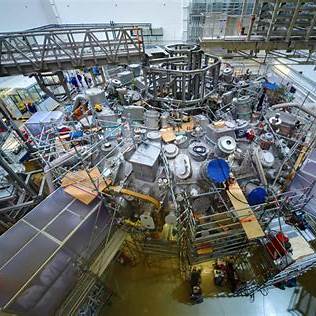
Germany Edges Closer to Taming the Power of the Stars
In a laboratory in northern Germany, physicists are edging closer to what could become one of the defining technological feats of the century: a nuclear fusion reactor capable of producing clean, abundant energy.
Fusion replicates the process that powers the Sun, fusing light atoms—typically hydrogen—into helium and releasing immense energy. Unlike fission, which splits atoms and leaves behind long-lived radioactive waste, fusion produces neither carbon emissions nor hazardous by-products. If mastered, it could transform the global energy landscape.
Germany’s “Stellar Heart” project, developed at the Max Planck Institute for Plasma Physics, is now entering its final phase of testing. Its core—an intricate metallic vessel containing a violet, superheated plasma—must be held in place by powerful magnetic fields at temperatures exceeding 100 million degrees Celsius. The goal is to sustain this reaction long enough to feed electricity into the national grid by 2030.
The design, known as a stellarator, is among the world’s most advanced. Unlike the more common tokamak reactors pursued elsewhere, the stellarator offers superior stability, a potential advantage in maintaining continuous fusion reactions.
If successful, Germany could become the first country to generate electricity from fusion on a steady basis, positioning Europe at the forefront of the clean-energy transition. The implications extend beyond physics: a reliable fusion power source would rewrite energy geopolitics, reduce dependence on fossil fuels, and mark a decisive step toward carbon neutrality.
For now, the violet plasma inside the Stellar Heart remains caged light—brilliant, volatile, and just out of reach. But for the scientists overseeing the experiment, it represents more than a technical challenge. It is a glimpse of a future in which humanity learns not merely to burn fuel, but to harness the fire of the stars.